Sunday, October 14, 2012

Project 2: Friday Notes and Overall Theme

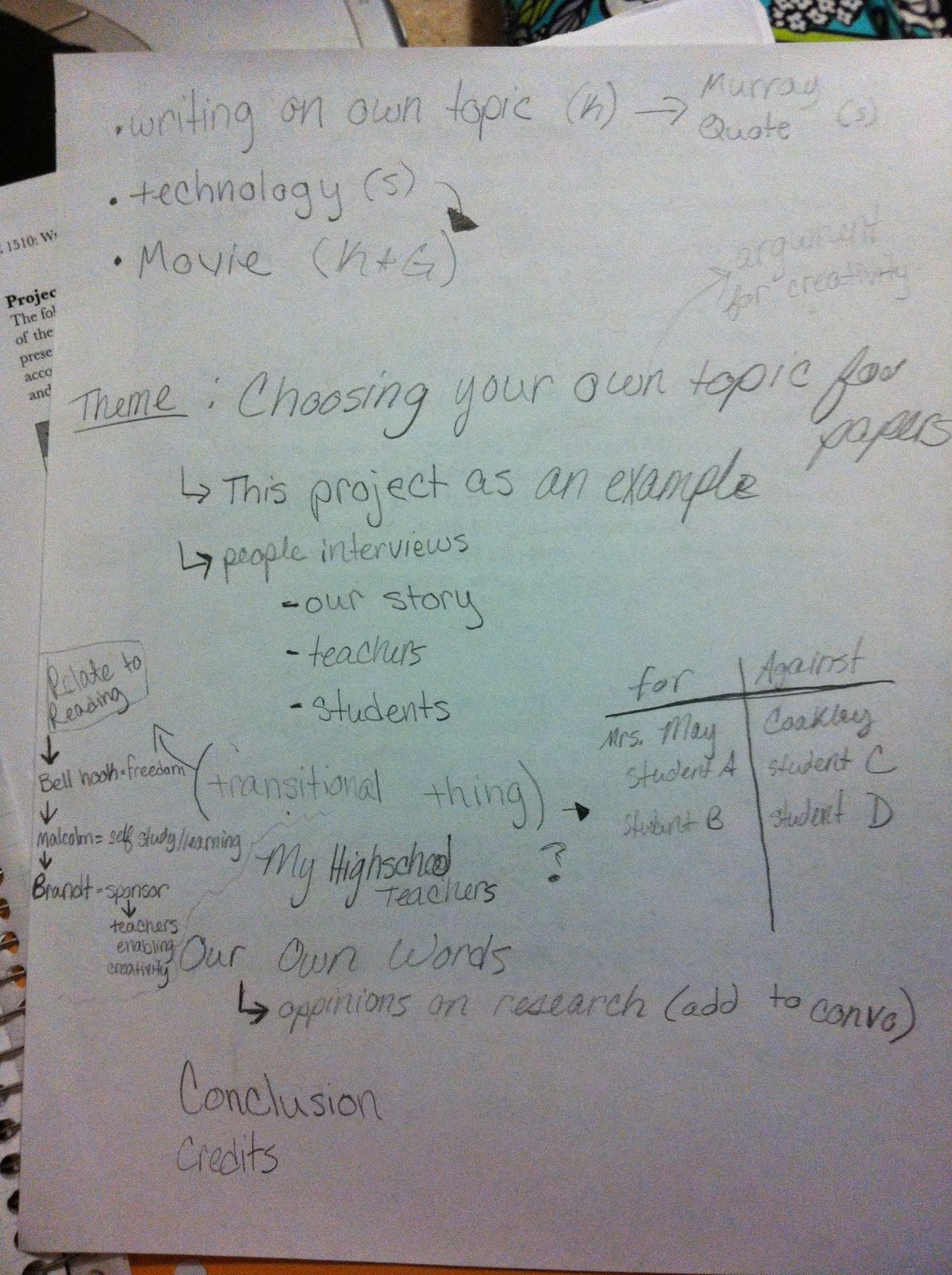
On Friday we collectively combined all of Ms. May's comments on our blogs about Project 2 and used them to define our argument and strengthen our topics relation to the texts read in class.

Our "Theme Notes" were as follows:
  1. Students should have freedom to shape their literacies rather than being receptacles in which a teacher pour his/her topics.
  2. Do required topics disempower literacy?
  3. Do we ever act in society with complete freedom?
  4. Freedom is a motivating factor for literacies.
  5. Without student freedom and involvement, literacy loses its motivation for students.
  6. What would be the benefits of a liberator classroom?
From this we obtained our overall theme- or argument. 
  • The freedom to choose a particular topic to write about gives students the opportunity to shape their own literacies, encourages and motivates student involvement , and promotes creativity. 
So far, our general relations to the texts we have read in class are:
  1. Hooks: She progressively frees herself from her past as she writes about it. By willingly choosing to write about her own past, she is motivated to learn from her own story. As she has trouble writing her own autobiography, she becomes more involved in simply understanding herself. Writing for hooks as an outlet for self change. 
  2. Malcolm X: He became literate by choice. He then read topics of his choice and became a writer. Malcolm's situation motivated him to create his literacy rather than shape what he already had. 
  3. Brandt: Teachers have the ability to inspire and enable student creativity as sponsors of literacy according to Brandt. Confining classes to a particular topic halts such advancements. 
Methodology:
     As stated in my previous blog post, we are doing our presentation via video. Kenny and Garrett have experience in that area. Each of us will touch on our theme notes in the introduction and throughout the video. Each of us will also give our own story on how we came to agree on this topic and why it is important to us. Garrett is going to discuss the relation to Brandt, Kenny will discuss Malcolm X, and I will discuss hooks. We will interview students and teachers about their views on our argument. Finally, we will  conclude our argument and state we have learned in our research. 

Thursday, October 11, 2012

Project 2 Progress

Literacy Data from WAW 460-1
I learned to read and write from my grandma/babysitter, my parents, and my older sister before I went to kindergarten. 
I've written a lot for school and scholarships. I've written letters to soldiers- and one in particular. I used to write songs to play on guitar. I write tons on the internet. I used to spend literally hours coding my myspace to look awesome...
I enjoy letter writing, song writing, and posts on the internet-- not so much writing for school (too systematic for me)
I HATED term papers in high school…but in junior high I played saxophone and I learned to read and write music and that was pretty cool for me. Im not a band-aid anymore but the skills stuck. 
I remember reading this book about a chicken when I was four. Its still in my house somewhere, but I was so excited when I finished I remember running down the hall to tell my mom. As for writing, I actually remember one of my mom's friends teaching me to draw stars when I was about 3 or 4. My grandma taught me to write my name when I was four as well- that's when I started writing. 
As I was learning to read and write, I thought I was the coolest kid ever since the adults praised me for it. I guess that's what made me realize how valuable the skills were going to be as I grew up. 
When I read in school, I hated coming across words that I didn't know. I was 2 years ahead of my grade in reading- so when my friends were reading 1st grade books, I was tested on 3rd grade books. I didn't think that was fair and I would've liked to stay on the same level as my friends. However, once I finally understood a word or once I quit having so much trouble with the vocabulary, it was refreshing.
I definitely prefer fiction.
The majority of the writing I do at this time in life is for English 1510… but in general, I do so much school work involving reading and writing that I don't have time to do anything else. If I had it my way, I would go back to writing some music and Id have more time to email friends or text or something. I just hate being told to read/write this by this time. I like to do things on my own time at the spur of the moment. 
This class has kind of made me hate reading- though if I came across a good fiction book in the future, I think my hope for reading would be restored. As for writing, I don't think I'm too bad at it so I guess it doesn't really bother me that much. Id rather right on topics on my choice though. 
It is ultimately my early family influences and school that has made me the reader and writer I am today. Technology, music, and long distance writing has influenced me at different times in life. 
Literacy sponsors: Grandma, Mom, Dad, older sister, Army ex-boyfriend, teachers/school, technology, music, the library, ….we probably share many sponsors. 

These are the answers to the self study questions in WAW. 
For a little more personal insight on the history of my literacies, check out my literacy narrative. 
http://smaccombs.blogspot.com/2012/09/literacy-narrative.html

Summary of Emerging Argument
As a group, we feel that having the choice to choose the topic you write on is better than being given a topic. Having the  freedom to write on what pleases you enables creativity and is more enjoyable in our opinion. This theme of freedom can be related to hooks' article because she is progressively more free from her past as she continues to write about it. Also, Malcolm X became literate by choice, not because he was told too. He read topics of his choice and became a writer due to all of it. Aside from what we have learned in class for evidence, we intend to question others' views on this topic and present them and our conclusions to the class.

Group Notes and Contributions
I feel to best portray group notes and contributions, a view of our work is necessary. Here are our notes. We have decided that due to Kenneth and Garrett's strong background in movie production, our presentation will be through a video. Also, we intend to interview professors for and against our topic, below are possible interview questions I have jotted down. I feel that all three of us are working efficiently and will produce a great investigation about literacy.


Sunday, October 7, 2012

Reading Response: "The Sticky Embrace of Beauty"


Readings on Writing (p. 78-97)
Reading Response
“The Sticky Embrace of Beauty” by Anne Wysocki

My Personal Thoughts:
I’m putting my personal thoughts first to apologize for any incorrectness or confusion throughout the rest of my response. To be completely honest- I had to reread this article a lot. I still do not understand it fully. The headings kind of helped me pull out the main points, but not enough. I’m still not real sure as to what Wysocki’s actual main purpose even was. This was an extremely difficult read for me. My summary seems lengthy to me, but I had to do it that way in order to understand the text myself. By far- my least favorite read and assignment.

Summary:
In “A Sticky Embrace of Beauty,” Wysocki attempts to explain her analysis of an advertisement found in The New Yorker that features an image of a woman standing to one side nearly naked wearing black thigh-highs, gloves, and heels. She states that she feels both pleasure and anger when viewing the ad. Wysocki details the causes of her pleasure and anger and provides several reasons supporting her feeling of pleasure. However, she had to assess existing approaches of image analysis to develop reasoning explaining how this image evoked anger.

In her essay, Wysocki explains several aspects of visual analysis from Robin Williams’s The Non-Designer’s Design Book, work from Johanna Drucker, and Rudolf Arnheim’s The Power of the Center. Though these works provide great detail in part of Wysocki’s analysis of the ad, she is concerned with egocentrism in viewing. She stated:
“Williams’ principles emphasize the layout as object, as container of abstract efficient form, as something to contemplate that has no effects on us as we contemplate; in parallel, I argue that Arnheim’s and Bang’s principles emphasize the layout equally as object, but now that object is a container of the form I experience as an abstracted body. In neither case is the designed object conceived as something made to establish relations between me and others; in neither case is the object conceived to exist in a circuit of social and cultural relations” (86).
Wysocki then explains Molly Bang’s Picture This: Perception & Composition, and she references Kant’s Critique of Judgment and Wendy Steiner’s In Venus in Exile: The Rejection of Beauty in Twentieth-Century Art. From all of the works discussed she explained the four basic design principles (contrast, repetition, alignment, and proximity), that our yearning for organization and consistency comes from a post-World War I effort towards efficiency, how different shapes effect our emotional responses, that specific elements in certain positions with particular directions can provide different meanings, and much more.
           
From all of Wysocki’s research she formulated her own ideas. She comes to summarize her anger when she says, “But what my analysis here shows me is that we should see this objectification- and the violence against women that can follow from it- as inseparable from the formal approaches we have learned for analyzing and making visual representations of all kinds” (93). Wysocki then closes with actual lesson plans of sorts to familiarize students with visual analysis. Wysocki’s main point to convey is that visual composition is rhetorical and that beauty is a quality we build.

Synthesis:
Wysocki’s article is all about the visual. Therefore, I would have to say that her article relates to the articles from Berger, McLoud, Bernhardt.

John Berger attempted to explain the cultural construction of advertisement as visual representation pertaining to gender. Berger argues that art is a representation of the world around us and that the images we see of women today originate from the tradition of the “nude” in older European art. There is a strong connection to Wysocki’s article because her whole basis was from an advertisement of almost-nude women. Wysocki talked about the objectification of women visually, and Berger described why that happens.

McLoud mostly talks about comics and symbols, buy he explains why writers use them. Wysocki relates by talking about the basic design principles and layout.

Bernhardt attempted to explain the importance of visually appealing texts and how to achieve them.  Bernhardt argues that layout and rhetorical organization are important in creating a visually appealing text. This is almost synonymous to the explanations put forth by Wysocki because her whole essay is based on an advertisement and its appeal to a viewer.

3 Questions:
1.     On of the highlighted sentences in the text (and one that I could actually read without jumbling my words) was, “Form is itself always a set of structuring principles, with different forms growing out of and reproducing different but specific values.” Though I could read it, I cannot comprehend it. What does this even mean?

2.     Was it just me, or did the headings make the reading even more difficult? I felt like they did not follow the flow of the text—if you could even detect flow.

3.     I was totally lost when Wysocki was explaining Kant’s work. What does Wysocki mean when saying our judgments of beauty “must be disinterested?” (90)

Friday, October 5, 2012

Reading Response: From Pencils to Pixels: "The Stages of Literacy Technologies”


Writing About Writing (p. 422-441)
Reading Response
“From Pencils to Pixels: The Stages of Literacy Technologies” by Dennis Baron

Summary:
In “From Pencils to Pixels: The Stages of Literacy Technologies,” Dennis Baron attempts to explain the histories of writing technologies, including those that are not usually viewed as technology at all. Baron argues that every new writing technology in time has had to become established and learned. He suggests that each new writing technology’s acceptance relies on its accessibility, function, and authentication. Baron describes several writing technologies including writing itself. He details the history of the pencil, the printing press, telegraph, telephone, typewriters, and the most recent technology- computers. Each writing technology underwent some form of criticism in its beginning years but as time went on they have become known as natural rather than technological. Each technology affects literacy and Baron’s main acquisitions are about the advantage or disadvantage of the computer and what its affects will be in the future.

Synthesis:
Baron’s article is most strongly tied to Brandt’s article about sponsors of literacy. Every single writing technology, even writing itself, is a sponsor of literacy-it could be reading literacy, literacy in that specific technology, or literacy in technology in general. Also, the internet (used from a computer) can influence any specific literacy just being doing searches. Therefore not only would the computer itself be a sponsor but the Internet, too. Nearly all forms of technology influence literacy for that matter.

Baron’s article also relates to the articles by Malcolm X and Alexie. Both X and Alexie tell the story behind their personal literacy and the sponsors they named are reviewed in Barons article. Malcolm wrote with pencils in dictionaries that were written and printed using writing technology. Alexie learned from comics, cereal boxes, and books- all of which written and printed using writing technologies. Essentially every topic in Baron’s article details this history of literacy itself.

My Personal Thoughts:
I found this article to be very interesting. I never would’ve fully understood that even a pencil was a writing technology without reading this article. It was interesting to read the history of the pencil and other writing technologies as well. One fact that really stood out to me was that Alexander Graham Bell actually wanted to sell the patent of the telephone to Samuel Morse- and he refused fearing that no one would want the telephone. It’s crazy to think about people criticizing the technologies that we often take for granted.

It was also neat to read an article about computers that was written in 1999. Some questions presented in the article appear to have answers now, and some questions seem peculiar to think about at this time- but that must have been the mindset of 1999. Thirteen years can certainly make a difference. Perhaps now the same article would include information about e-mail, different word processing abilities, or maybe even texting from cell phones. Overall, this was a very interesting article and I liked reading about past technologies that have influenced literacy throughout history. 

Wednesday, October 3, 2012

Reading Response: "writing autobiography"

Readings on Writing (p.177-180)
Reading Response
"writing autobiography" by bell hooks

Synthesis:
           The article by hooks details her experience in trying to write an autobiography of her childhood as well as childhood memories themselves. Her article is related to Brandt's article because she describes influences in her childhood that may be hindering her ability to write about her past- thus describing a sponsor of her literacy which is what Brandt explained. This article also relates to Malcolm X and Alexie's articles because all of them describe a part of their past and things that influenced their literacies (whether it was reading, writing, or understanding in general). hooks also relates to Kleine because she is hunting and gathering for information- not in books- but in her own mind. In a distant way, hooks relates to Allen in Diaz just because she is not an inspired writer and she is having trouble writing her childhood autobiography just as Diaz had trouble writing his work. 

Reading Response: "The Joy of Reading and Writing"

Writing About Writing (p. 362-365)
Reading Response
"The Joy of Reading and Writing" by Sherman Alexie

Synthesis:
         Alexie's article relates closely to the articles by Brandt and Malcolm X. Alexie describes his past experience in learning to read and the things that influenced him. His literacies arised from comics, old random books, Indian culture mixed with American culture, and his drive to be smart. All of these things, as Brandt explained, were Alexie's sponsors of literacy. Malcolm too described his history of learning to read and his sponsors of literacy. So, essentially, Malcolm and Alexie are stories that support Brandt's claim of there being sponsors to one's multiple literacies. 

        Alexie relates to Elbow just because he uses voice, and he relates to King. He relates to King because King wants writers to be serious- and Alexie was so serious about his literacy that he became a writer himself, and award winning one, and he tries to pass that on to the students at the schools he visits. 

Reading Response: "Learning to Read"

Writing About Writing (p. 353-360)
Synthesis
"Learning to Read"by Malcolm X

Synthesis:
         This article was all about the author's life experiences that led him to read. For that reason, "Learning to Read" relates mostly to the article by Brandt. Brandt's article explained how there are sponsors of literacy, or things that effect someones literacies. Malcolm explains several sponsors. First, being in the street was a sponsor that hindered his reading ability. However, after going to prison- the library in prison itself was a huge sponsor of historical and educational literacies in Malcolm's life. Malcolm explained that people- such as Bimbi, Ella and Reginald (his visitors), debating prisoners, the authors he chose to read, Mr. Elijah Muhammed, and Parkhurst- all influenced his want to read, and his literacies in the subjects they promoted. The dictionary itself could even be considered a sponsor of Malcolm's literacy in vocabulary and writing. Also, Malcolm's interest in the oppressed non-white man contributed to his literacy. Brandt's article and Malcolm's article are closely related. 

        Malcolm's article also related to other authors we have read in class. In a way, Malcolm demonstrates a true gatherer of information as described by Kleine because he dug deep into his books for discovery. Also, Malcolm's work comes from his autobiography- which is most certainly a time to use voice. He did use voice, and therefore can be distantly related to Elbow.